Showing posts with label Supportiveness. Show all posts

Sunday, March 04, 2007

Not Really Trying

Dear Andrew,

I recently read the story you called "Missing the Game of Life." I agree with your response to the woman who was writing but have a related question to your answer.

How do you insist that your husband change? I mean, I would love to just go to my husband and say – you need to do more around the house, I am not happy with our current situation, etc. and believe me I have tried that in the past but I only come away feeling guilty for even bringing up the subject to begin with.

A little history . . . my husband is 12 years older that I. We have been married 18 years. He has a definite problem with clinical depression – in fact has been diagnosed as bi-polar with depression being predominate. To add to the mix he is a licensed counselor although he does not do that currently. He has a definite tendency towards being a hypochondriac and often acts like a chronic victim.

In our marriage it has meant that often I pick up the slack and do “everything” other than have a job outside the home. We have 3 children one of which is special needs and I have been a SAHM for a long time now.

In the past 7 years he has lost 3 jobs – one of which was a dream job – due to his depression, being “victimized” by his bosses, etc. It has been a horrible roller coaster ride with health and financial losses.

We attended counseling about 6 months ago and it was somewhat helpful at the time. He also sees a psychiatrist for the bi-polar/depression and takes medication for it.

When he is having a “hard” time at work, etc. he comes home and doesn’t do much of anything but talk with the children (he is a good dad) and watch TV. I do everything else – clean, cook, laundry, grocery shop, do household repairs, take care of the cars, plan for the kids and their needs, home-school my special needs son, take my girls back and forth to their extra activities, handle the finances, pay bills, etc.

He will help if I ask him to do something and is supposed to have the regular job of taking out the trash but if he is depressed that will get ignored unless I point it out.

My problem is that when I approach him about either helping me – like please put your glasses and dishes on a certain side of the sink so the other side can be used to fill glasses, etc. – he makes me out to be some weirdo for even asking.

If we sit down and I try to bring up issues he gets extremely defensive and says things like ‘I am doing my best’, ‘I am depressed’, etc. and has this way of turning the issues around so that I am the bad guy and I am picking on him. I tell him sometimes that he puts on his “counselor” voice and says “I am doing the best I can.”

We learned in counseling that I have a tendency to be too harsh (according to him) when I bring things up but when I try to soften it, rephrase, etc. the result is always the same . . . He says he will TRY to do his best and sometimes things improve for a few days but it does not last.

I know that I enable him to “be depressed” and just not do anything because I will do it (I learned that from my counselor) but how do you get a depressive person to want to change and how will the household continue to run, if I don’t do it?

I wish it was just as easy as saying – gee, honey I need more help and need you to be more involved and take responsibility and keep a job – but it does not work that way for me.

I am at the point of thinking of leaving him simply because I am tired of having my life (housing, income, health insurance, etc.) being decided by someone who is just going to TRY to do his best. I would rather succeed or fail on my own merits than be dependent on him.

There really is a long, long history here that I can not really get into but I feel sort of desperate. He has once again “lost” a job in that he has been demoted and has to take a pay cut. He knows how this is like the last straw to me and when I tearfully asked him if he would promise me to not lose the current job his response was “I will TRY to do my best.” I want to scream: "Obviously your best is not enough, don’t just try to do it, do it.”

We tried to talk last night about the situation and I tried to bring up how I feel and how I don’t trust him to keep the current job and think of his family first. I know that it was not fun for him hearing that from me. But he turned it around again and said how I was getting off topic and how much humiliation he has taken from his superiors in the past and his current boss and how he has stayed with the jobs “because of the family.” But he then loses the jobs or just quits (he once just quit a job because his boss “yelled” at him too much).

How do I approach this? How do you insist that someone change? How do I express what I need and get his cooperation in fulfilling my needs?

Signed, More Than Just Trying


Dear More Than Just Trying,

Simply insisting your partner should change is effective only when the problems are relatively minor. For example, if a husband is merely unaware of how much his wife needs his help, then her insistence may bring this to his attention. That might be enough in that instance to prompt him to respond to her needs. That can only happen, though, when a relationship is generally robust, with many other positive characteristics. The scenario I described only works if both people are generally predisposed to be supportive of each other and the husband merely needs a nudge to bring this to the fore. If, on the other hand, trust, closeness and supportiveness tend to be in short supply in a relationship, demands for change rarely have any long-term effect.

Telling the chronically unsupportive spouse to step up is similar to informing the long-term smoker they should quit, or the chronically overweight person they should lose weight. People in these types of circumstances are already aware of the issues. They already know their partner is unhappy with the status quo. Informing them yet again about this fact does little to change the situation.

Generally the answer lies in developing your relationship to the point where both of you feel good about doing nice things for each other. It's about developing an attitude of mutual supportiveness in all aspects of life. This is made more difficult in your case by your husband’s personal life challenges. He is incapable of meeting even his own needs for fulfillment and achievement, which makes it even more difficult for him to provide for others.

It is good and necessary that he is seeing a psychiatrist for his bi-polar symptoms, but the results prove that is not enough to address all of his needs. He also needs a life skills coach. Many people might assume that would be part of the service when seeing a psychiatrist, but often this is not the case. The psychiatrist’s focus is on responding to the acute depressive symptoms; the response usually comes in the form of medication. Assuming the prescription is effective, the result is typically a person with a somewhat improved ability to respond emotionally to life’s challenges. As you can attest, though, your husband still has bi-polar symptoms, though hopefully less severe than they might be otherwise.

So your spouse still has emotional challenges and must try to deal with a plethora of ineffective life skills and habits. For instance, he seems to have a habit of turning your requests for change into discussions about how you request change. This means you spend all your time talking about how you fight, rather than the issue you wanted to address. This is a classic mistake. A more effective strategy is to ban this as a discussion topic when attempting to resolve conflict, and to consciously keep the discussion on the underlying issue.

Your husband would benefit greatly from working with a life skills coach. He could use help with developing strategies for meeting challenges rather than running away, resolving conflict, and no doubt a number of other strategies and skills. At some point it also makes sense to involve you so ineffective patterns of communication and interaction between the two of you can be replaced. At the beginning, though, the primary focus should be on helping him learn to cope. Such skills can be taught, and they most certainly don’t come out of a medication bottle.

If interested, he could talk to his psychiatrist or other health care professional about where to find such a coach in your area. I suspect this could make a significant difference in your lives. Good luck!

All the best,
Andrew
Read More ->>

Monday, January 29, 2007

Dismaying Story #107: The Sponge Lady

Dear Andrew,

I am a forty year old woman with a husband and three small children. Though my husband is a very nice man, we used to have disagreements over the division of household tasks and the issue of him and the kids being messy. We stopped having disagreements because I gave up and just did everything myself. I see now that I shouldn't have done that, but to make a long story short, it was out of life-long habit that I did so. I have recently discovered how much I still resent the losing battle that led me to just give up like that. My husband and I have been discussing the topic recently and he is angry with me because I have resentment over that old situation. I think the only way to get rid of the resentment is to work something out now that would seem fair and reasonable to both of us. We are just beginning to talk about this and we have just started re-organizing some rooms in the house. Also, we don't have a lot of time to devote, so this will be a slow (agonizing) process. Now I see anew why it was so easy for me to just give up.

My husband feels personally attacked if I desire something that he thinks is unreasonable and he also feels this way when I bring up the previous pitfalls that made me throw in the towel. If I don't bring up what went wrong before, how can we avoid the same outcome?

I gave up my job to take care of things and became a homebody. After years of following my family around with a sponge, I just can't take it anymore. I'm tired, disillusioned and the house has become disorganized and it's starting to get messy. My husband does do some things now that he didn't used to do, like cook and wash the dishes and I appreciate it very much, but what I need most is for me and my husband to be able to work together to really set things right again in the house and come up with a fair plan that involves everyone.

I can't seem to help complaining to him about how I got into this mess - he's the person I talk to about everything! But, still - I don't want to fight about it.

What can I do? It seems that my choices are:

1) forget the whole thing, suck it up, be quiet, trudge along doing the best that I can and try to find a way to be happy with it (this doesn't work for me anymore); or

2) keep working with my husband on reorganizing and talk to him about my needs and feelings around this, let him get angry and defensive, endure the arguing (which we both hate) and then hope that something good comes of it.

The second choice worries me because we both have baggage and I'm afraid it will all come bursting out of the closets and bury us. He was raised and catered to by a Mrs. Cleaver type, while his father was demanding and disapproving. I was the 'Cinderella' of an extremely dysfunctional and abusive family. We are both dealing with the after-effects of abuse from my past, in the sense that any hint of physical closeness and sexual excitement can send me into a panic attack. I'm seeing a therapist, but still I'm afraid I might be like this the rest of my life.

Surely there must be other choices for dealing with our impasse. I would even be okay with a way to make choice #2 bearable. Do you have any ideas?

Signed, The Sponge Lady


Dear Sponge Lady,

You have many issues going on all at the same time, any one of which would be difficult to deal with on its own. I'm glad you're getting professional help.

It can be easy in your situation to come to the conclusion that your husband is lazy when it comes to housework or that he doesn't care about your needs. While I've seen those elements before, I think the dominant element for you is misunderstanding. Your husband's mother taught him it was "fair" for the woman to look after the house and the kids. Since you are a full-time homebody, he likely has the same understanding as many other men -- that you have plenty of time to do the housework. He undoubtedly figures that he has his job and you have yours. He doesn't ask you to help with his, so it isn't fair to expect him to have to do yours. He probably figures he is already going above and beyond the call by doing more cooking and dishes than his father ever did, and STILL you complain.

Men want to be appreciated and considered competent. When you ask for more, it is easy for him to hear, "You are failing me." If he already feels he is trying hard, this is an incredible turn-off for him. "Why should I try harder?" he thinks to himself. "No matter what I've done, she still tells me I am failing her." There is the source of his resentment. He doesn't resent the idea of being supportive, he just wants it to be "fair" and for him to be appreciated.

One fundamental problem is that he doesn't understand your need for more help. He doesn't understand that being a full-time parent and homemaker is more than a full-time job. If you can, get him to read this article about Traditional Work Sharing. Many men have the common misperception that it is fair to treat the housework as "her job" for the stay-at-home mom. In that article I explain why that is anything but fair. If you can get him to understand this one point, you will be a long way to resolving your issue. Thanks to his Mom you have an up-hill journey to reach that point.

The other thing you can do is adjust how you approach the issue when you discuss it. Be aware of his need to be appreciated. Which do you currently do more: tell him how much you appreciate the things he does, or suggest that it would be great if he could do more? You will help your own cause if you can get into the habit of loading up on the former, which will help pave the way for doing the latter.

I would stay completely away from bringing up the past failures. I disagree that this is a necessary step to future success. Instead, it merely re-opens old sensitivities and makes him feel attacked.

Start the conversation by giving him a gift instead of what he perceives as an insult. Maybe you could explain that you now have a better understanding of the situation from his point of view and you're sorry that the way the two of you have dealt with the situation up until now has made him feel criticized. Tell him how much you appreciate what he is doing. Offering an olive branch is often the best way to start a dialog, since this sets a tone of conciliation, goodwill, and cooperativeness. Often your partner will be prompted to respond in kind.

So in short, you need a way to get him to alter his "Mrs. Cleaver" view of the world, and you need a more effective way of communicating so you don't unintentionally insult him and make him defensive. Often the key to the communication is having an empathetic understanding of how stressful the situation is from his point of view. Get him to have the same empathy for your situation and you should be well on your way.

I have focused on your housework question, but I'm also aware you have larger issues stemming from past abuse. No doubt it is more difficult to work through supportiveness and communication problems when your closeness is compromised as you describe. I'm sorry to hear of all your struggles and I wish you and your husband all the best as you work through them.

With warm regards,
Andrew
Read More ->>

Monday, January 01, 2007

Dismaying Story #97: The "Untainted" Woman

Dear Andrew,

One year ago, at the age of 41, I married a man that I had been with for 5 years. Those years were tumultuous, full of growth that was brought on by a lot of arguments. Somehow, we decided to marry, thinking we could continue to grow into a healthy relationship. This is my first marriage, and his second. I had not had a lot of intimate relationships before this, and he has had many women in his life. He says that one of the reasons he chose me is that because I am "untainted" in regards to men.

I have some insecurities that are based in my childhood. I have worked to grow past them and have done a relatively good job so far, with a bit more traveling to do. The big problem is that I cry. I cry when my husband says something that hurts. This further irritates the problem between us. He gets angry, which makes me cry more.

When this happens, he will reach out to other women via the internet (not meeting them in person, as far as I know). He tells me he is not getting his needs met emotionally from me, so he seeks that out elsewhere. I call him on it, he denies it at first, then admits that yes, he is chatting with other women. He says it is a "distraction". Of course, this does nothing but to make me feel more insecure.

I need to learn how to deal with my insecurities and how they feed into the problems we have in our marriage. I also need to make the tough decision as to whether I should leave the marriage, and more than likely spend the rest of my life alone and bitter. This man has a lot of qualities that I admire. I searched far and wide to find someone that met my very specific criteria for a mate. When I met him, I felt he was the one I wanted to be with.

My questions for you:
  • How does a woman meet the needs of her husband emotionally?
  • -From your perspective on the limited information I have written here, am I wasting my time in this marriage?
I did not marry to get divorced, yet this is causing a lot of stress in my life that is affecting me in other areas.

Signed, Wondering What to Do


Dear Wondering,

I have been wandering around on this planet for quite a number of years now and to the best of my knowledge I have never met a tainted woman. The fact that your husband views women who have had previous relationships as somehow spoiled or corrupted as a result ... well, that seems bigoted and highly conceited.

When you display distress (crying) it makes him ... angry? I understand it would be stressful and frustrating for him when you display emotion he doesn't understand and therefore feels powerless to remedy. I would expect a supportive husband, however, to react to distress on your part with concern, compassion, caring, a desire to help you -- something along those lines.

"He tells me he is not getting his needs met emotionally from me, so he seeks that out elsewhere." Wow. What an emotional blow to the head that is. "You know honey, you're just not good enough for me. And by the way, whenever I feel dissatisfied (which happens all the time), I'll just get my jollies from other women instead." He is having emotional affairs with these other women, which are every bit as destructive to your marriage as sexual affairs. And it wouldn't surprise me if someone with his obvious lack of commitment is headed for sex as well, if he hasn't been there already.

Are you kidding me? Does he honestly believe these are reasonable behaviors within a marriage? You don't say what criteria you were looking for in a husband, but I can't believe your goal was to find someone who is bigoted, unsupportive and unfaithful. There are clearly reasons why he has gone through a large number of failed relationships.

I honestly don't know what kind of wife could meet the emotional needs of a guy like that. I expect she would have to care only about his needs and have none of her own, let him do whatever he wants without complaint, and never present him with any kind of problem. Have you ever met a woman like that? I haven't and I hope not to, because it would make me sad; she would be an empty shell of a person.

How much better it is to have a wife who yearns for life, who has normal needs and desires. Sure, we all come with our own form of baggage, but that's just the normal price of admission for playing the game called marriage. When he said those vows, he agreed to stick with you in good times and bad, which means helping you with any problems you might have. Your crying is not "the problem." It is merely a symptom of your distress. He's not living up to his end of the bargain; he's simply running away instead.

Your letter implies that you have somehow let him down by not meeting his needs. I don't see it that way. You both have needs. He refuses to help with yours and then runs away so you have no opportunity to address his.

You have described two major issues in your relationship. The first is your fear and insecurity, which arises from childhood events and circumstances. I guarantee this has contributed not only to the difficulties you have had in this marriage, but also in your apparent reluctance to get into a relationship at all. Your personal road to happiness lies directly through the resolution of these issues from your past. This is not something you need to fix in the context of your marriage, but simply for yourself. If you have not already done so, I highly recommend you find a coach or therapist to help you with this resolution.

The second major issue is your husband. He needs to understand that he is not stepping up and being a man in this relationship. He is acting like a spoiled little brat who is used to getting his way and who runs off and cries to someone else if that doesn't happen. He needs to learn how to be empathetic, giving of his time and emotion, and supportive of your needs. He doesn't yet understand that doing so is the only way for his needs to be met; that is the only way he can ever have a partner who shows him how loved and appreciated he is for all his support.

With work, patience and the right help, you should be able to resolve the first issue. I don't know how likely it is, though, that you can resolve the second issue. It sounds like he believes you are the problem, and he would probably resist the idea that he should change. Even if he did come to that realization, he would have to be willing to address long-standing attitudes and poor relationship skills. And at this point he is clearly not committed to you, your needs or your marriage. He would have to swing a long way over to the side of supportiveness and openness, and stay that way for quite a while to heal the considerable hurt he has caused you.

I can't recommend which way you should jump, but you clearly have a steep hill to climb if you want to turn this relationship into a happy place to be.

Finally, I completely disagree that you would likely end up alone and bitter for the rest of your life if this marriage fails. I have seen incredible turnarounds in people's lives when they get the coaching help they need to quiet those inner voices that keep reminding them about the traumas from their past. You will be amazed at the difference this can make for you, and the possibilities it can open up for your life, regardless of who you end up with. I wish you luck in achieving that peace and happiness.

All the best,
Andrew

And to everyone else who is reading along, I wish each and every one of you the very best for 2007! May you all find peace, happiness and satisfaction in glorious achievement in this new year.
Read More ->>

Wednesday, November 22, 2006

Dismaying Story #85: Love is a Verb!


Today's question is the most succinct I have received, as well as one of the most significant since it pertains to choosing a life partner.

Dear Andrew,

How do you know when a man really loves you?

Signed, Wondering


Dear Wondering,

I once talked with a man who was in the midst of a career change. He was moving to a new city for a couple of years, and then he would be assigned a position in yet another city. It was highly unlikely that this work would ever take him back to his hometown. He decided to make this move knowing that, for a variety of reasons, his wife and young children were staying in the hometown.

I told him that no career aspiration would ever be important enough for me to move away from my family, that I simply loved them too much. This made him angry. "You have no idea," he said, "how much I love my family!"

As I reflected on this conversation later, I came to the conclusion that he and I used the word "love" in entirely different ways. He was talking about the intense emotion he felt inside. Despite how he phrased his response to me, he was referring to love as a noun, as an inner feeling.

To me, though, love is a verb. It is expressed by our actions toward others. When I say I love my family, I mean that I do things for them in an effort to make their lives better. Sure, this results from those strong feelings I harbor in my heart, but by themselves those feelings have no impact whatsoever on the people in my life. It is only when I translate those feelings into action that my love has a chance to enrich those around me. I could simply adore my wife and children, yet if I abuse, ignore, abandon, or otherwise treat them poorly, what good would my feelings of affection be to them?

I interpret your question to mean: "How can I tell when a man really harbors a deep and abiding love for me in his heart?" (And by the way, the question is equally valid when asked by a man about a woman.) In other words, I believe you are asking about love the noun. My answer is that you will never -- can never -- experience this type of love directly. It will always be hidden from view. I believe you should be concerned with his actions toward you. How do his feelings translate into behavior? What do you experience as a result of being with him?

Does he do supportive things for you? Does he make you feel good about yourself and about the two of you as a couple? Does he let you know that he cares, or does he keep it inside and assume you should just know? Are you doing all the giving in this relationship, or do the concrete expressions of love flow in both directions? Has he learned what makes you happy and what stresses you? More importantly, does he make an effort to do the former from time to time, and to avoid the latter?

In other words, if he generally treats you well, what more do you need to know? And if he doesn't, then that may be all the answer you need.

Here is another possible interpretation of your question: "How can I tell if he loves me enough to stay with me forever?" Unfortunately, as in other areas of life, there are no guarantees in love. If he has proven himself to be a caring and giving individual, though, and he seems to love being with you, then hopefully there is a good chance that will continue. Talk with him about your respective views on marriage, commitment, and divorce. How does he react when people you know get a divorce? Again, there are no guarantees, and every relationship must withstand highs and lows. Hopefully you can get a sense of how committed he is to your relationship.

I urge you to resist the following thought: "I am not very happy with the way he treats me now, but I know things will be better once we are married." If you have had this thought, you should think seriously about whether this is the relationship for you. In the vast majority of cases, what you see now is what you will get later. Do not count on changing him (or her, if you are a guy).

Finally, this is just one way to approach your question. I bet many readers will have other ways to gauge how their partner feels about their relationship, and these approaches are sure to be equally as valid as my thoughts. Make sure you drop back and see what others have to say. Hopefully you will find a few nuggets amongst the collected advice that will help you in your own situation.

All the best,
Andrew

The Question of the Week is about negative self talk and how it can inhibit our success in life. I'd love to hear your thoughts, so take a moment today and leave a comment.
Read More ->>

Wednesday, November 15, 2006

How to Ask My Husband for Help


This post is part of a continuing series entitled The Hunt for the Vacuum Cleaner Gene. Last month I posted on the topic of How Not to Ask Your Husband for Help, which looks at some of the natural tendencies people have when they try to ask for help from their spouse. In particular, last month's post examines why these approaches often backfire.

Today I begin looking at a more effective approach by examining several subtle variations of stating requests for help, and the hidden messages you should avoid delivering.

This is what it should look like:

NICOLA: Honey, would you sweep the floor for me?
SAM: Sure, no problem.

Short, simple and to the point. Your husband, on the other hand, might have other ideas:

NICOLA: Honey, would you sweep the floor for me?
SAM: You normally do the floors. Why are you asking me to do it?

Your request is not finished until the conversation is over. For the time being, stay away from the broader issues. They lead to immediate negotiation and possible confrontation. Keep the focus on the single task you are asking him to do. Restate your request and end the conversation as quickly as possible.

NICOLA: It'd just be great if you would help with the floor. Will you do that for me?
SAM: Okay.

As Sam has done above, your husband might ask: "Why should I help?" or "Why are you asking me now?" or "Is this because you don't think I do enough?" In other words, he might try to steer the conversation toward the larger long-term issues. Your first instinct might be to answer his question directly, like one of the following:

NICOLA: Because you never help out and I want you to start.
NICOLA: Because I really need more help around here.

Both of these responses make it clear that Sam's performance to date has been substandard, which he will take as a criticism. This is likely to lead to an argument about whether he already does his share. Avoid this by responding in a positive way, as Nicola does above: "It'd just be great if you would help..." Instead of criticizing past poor behavior, predict wonderful consequences (your happiness and approval) when he supports you in the future.

Avoiding Hidden Messages

Ideally you would like your request to leave your husband inclined to be supportive. You want him on your side, feeling good about himself and about you. Since supporting a wife and family is a natural role for a man, you can typically accomplish this by keeping your request simple. The idea is to avoid giving him an opportunity to read more than you intend into your words. Simply ask; nothing more, nothing less. Unfortunately, it can be surprisingly easy to give him a reason to object to your request. Here is an example:

NICOLA: I need you to sweep the floor for me.

At first blush this might seem like a reasonable way to ask. Nicola has stated her need simply with the implication that she would like Sam to respond to that need. Many men, however, will not see it that way. Notice that she has not asked a question; she has made a statement. Men will often interpret this as a demand rather than a request. Sam is likely to resent the idea that Nicola feels free to tell him what to do, that he has no say in the matter. Nicola, of course, was not trying to tell him what to do. That was the furthest thing from her mind. She will probably be surprised and frustrated by his resentment, which is the exact opposite of what she was trying to achieve. "Why," she thinks, "do men have to be so touchy? Why should I have to be so careful how I choose my words?" That's a fair question. In this case the issue is that most men hate feeling powerless in a relationship. Being told what to do evokes exactly that feeling. State your request as a question or you risk getting the same reaction from your husband.

The following variations tend to have similar negative results and should be avoided:

NICOLA: You need to sweep the floor.
NICOLA: The floor is dirty. You could get the broom and take care of it.

Another common mistake is to unwittingly include a criticism, like this:

NICOLA: I know you probably don't want to do this but would you sweep the floor?

You might be nervous or unsure of yourself if you are not used to asking him to pitch in. In that circumstance you might try to soften your message, make it seem like less of a demand with something like: "You probably don't want to do this but..." Unfortunately this opens the door for him to hear: "I expect you to refuse. I don't have any faith in you as a supportive husband."

Now this might be true. His past behavior may give you plenty of reason for doubting his willingness to help. Before you ask, you might even be fully convinced he will refuse. It is important, however, that you hide any such skepticism. If he gets the sense that you doubt his worthiness as a husband in some way, then he will be less inclined to support you and the whole deal can spiral downward. You are trying to move past all that mutual doubt and get to a place where you both have faith in each other as supportive spouses. You want to express optimism, which makes him feel good, then he wants to make you feel good, and so on. Now your spiral has a chance to shoot upward.

The key to getting that started is to state your request in a positive way, leaving out any potentially negative commentary. Here's another variation to avoid:

NICOLA: You don't have to do this if you don't want to but will you sweep the floor?

This carries the same implication; she doesn't think Sam will support her. A further problem with this type of request is that Nicola is telling Sam she is not serious about wanting him to help. She is offering him an escape route, practically begging him to say no. You could do the same thing like this:

NICOLA: I'm sorry to have to ask you this but would you sweep the floor for me?

Please. That just about sums up the entire myth of the helpless husband, doesn't it? You might as well say: "I know husbands aren't supposed to sweep floors and I really shouldn't be asking you this. You'd be well within your rights to refuse but would you sweep it anyway?"

Don't go there. You must cast off the myth and stop being apologetic about your need for support. It is right and natural that your husband should have a role in maintaining the household. Your words should reflect that. I'm not asking you to be aggressive or confrontational but you must find the courage to ask for help with some degree of confidence.

A lack of confidence can also make you want to explain your request:

NICOLA: Honey, would you sweep the floor for me? I have a ton of stuff to do because I have to pick up the kids in an hour and I need to have the kitchen straightened before then or I won't have supper ready before Emily's soccer practice.

Nicola has just delivered a couple of messages she should really avoid. First, her words make it clear she doesn't believe Sam wants to be supportive. If he wanted to, she wouldn't need the detailed explanation to try to convince him. As I explained above, men often perceive this as an insult. Even worse, she has implied that the circumstances are extraordinary so her need today is especially strong. In other words, Sam ordinarily shouldn't have to help out. Her request is just an exception and any help he provides is unlikely to become part of a regular pattern. This message is exactly the opposite of the direction in which Nicola should be trying to move.

To avoid these hidden messages, resist the urge to explain why you need his help. Keep your request short and to the point.

Of course, this is only one small part of the picture. You want your partner to pitch in willingly and repeatedly, to be a partner in taking care of the mundane household maintenance work. To achieve this, you might also need to watch out for body language, respond to his reactions in effective ways, and work around any objections on his part. I will examine these and other topics in future posts.
Read More ->>

Monday, October 16, 2006

Dismaying Story #69: "I Shouldn’t Have to Ask"

Last week I published a post entitled How Not to Ask Your Husband for Help. Several readers left comments and I would like to respond to some of them today.

Cairogal wrote: Here's the rub, for me, anyway. I feel that when I have to ask my husband to share the responsibilities, that somehow that makes it a favor. I don't like to have to say, "Babe, would you mind taking out the rubbish?" because really, that sounds like I'm asking him to help me, rather than assume a shared responsibility.

This was followed by an anonymous comment: Cairogal's comment struck a chord. I have felt like that too. What softened it for a while was saying thank you to whatever help was given, but soon that took on the same feeling too, like it was still my responsibility but thank you for helping. Now I just don't say anything (which still doesn't feel good) but just quietly consider it a nice bonus when something gets done.

I have seen this type of dynamic before. "Why should I have to ask him?" many women will say. "He should just know the work needs to be done and pitch in on his own. If I have to ask, it ruins it."

There is no such thing as a "one size fits all" solution, so if Cairogal's approach works for her, then more power to her. I wonder if it truly does, though. She wants her husband to assume a shared responsibility, but it sounds like that has not happened. If it had, then asking versus not asking would no longer be an issue. Clearly the anonymous commenter is not getting the level of support from her husband that she would like.

The issue here is that we all tend to interpret the world in terms of ourselves, and women and men have different approaches when it comes to cooperating and helping out. Women are more likely to sense need in others and give without being asked. To them, this is a normal expression of supportiveness.

Men, on the other hand, like to view themselves as competent. An unsolicited offer of help is sometimes welcome, but also may be taken as an insult. Don't believe me? Wait until the next time your husband is struggling with some task. It could be anything -- assembling a toy, finding someplace while driving, whatever. Put on a sweet smile and ask him, "Would you like some help?" More often than not you'll get back a grumpy, "I can do it."

Okay, now put these two people together in the same household. Unfortunately society has taught many of us that housework has traditionally been the wife's responsibility. This is often no longer practical given that dual-income households are now the norm, nonetheless this historical bias remains. So the helpful wife starts off doing more than her share. She waits for her new husband to do like she would do -- to recognize her need for a full partner and to pitch in on his own accord.

He, on the other hand, interprets her actions on the basis of what he would do, which is to handle a task until he can no longer do so and only then ask for help. Since she has not yet asked for help, he assumes she neither needs nor wants it. He believes all is well, while her frustration is building. Eventually she explodes into the "criticize, blame and demand" mode I discussed last week, which puts him on the defensive and lessens his desire to help. She now concludes that nothing works. After all, she tried waiting him out and then asking him, and neither had the desired effect. So she gives up and "considers it a nice bonus with something gets done."

Men are more likely to ask for what they want, while women are more likely to offer help to others without being asked. Men assume women will ask and women assume men will offer. The result is an impasse. You can’t fight Mother Nature – just ask him! The keys to doing this successfully are how you ask and how you react to his various potential responses. Some people seem to intuitively know how to do this effectively (and perceive their spouses as helpful), while others struggle with these skills and achieve less satisfactory results. I'll post more on this later.

Finally, Walker wrote: I have noticed that gender doesn’t matter anymore especially with more women in the work force.

True, my articles about equitable sharing of housework do have a gender bias, but there is a good reason for this. I have met couples where the husband does most of the work. Statistical studies continue to show, though, that women still bear the brunt of the domestic workload in our society and that this is a source of marital strife in many homes. The guys will have to excuse me while I address these articles to the majority.
Read More ->>

Wednesday, October 11, 2006

How Not to Ask Your Husband for Help


This post is part of a continuing series entitled The Hunt for the Vacuum Cleaner Gene. This series uncovers the many excuses we use to perpetuate some old-fashioned stereotypes. Many people believe it is normal and inevitable for women to be responsible for the bulk of the housework and parenting within their household. This series includes motivational posts that argue "why" these beliefs are largely unfounded, as well as instructional posts that move on to discuss "how to" effect change in your household. Previous titles in this series are listed in the sidebar under Supportiveness.

Today's entry is the first of the "how" topics, or more accurately it is a "how not to" topic. This article looks at some of the natural tendencies people have when they try to ask for help from their spouse. In particular, you should understand why these approaches often backfire.

Approaches that Don’t Work

Criticizing, blaming and demanding:
Let’s face it, people commonly put off asking for help until they are completely fed up. Suppose you’ve had a long day, you’re exhausted and you’ve just finished feeding, bathing and putting your two young children to bed ... alone. You emerge from your daughter’s bedroom to find toys everywhere, a dirty kitchen and a husband who, as usual, is making no move to deal with any of it. Something snaps inside and you feel a surge of outrage. Suddenly you couldn’t care less whether he likes it or not—he’s going to start pulling his weight, dammit!

So you launch in. “I’m sick and tired of you just sitting there while I do all the work around here. You never do anything and that’s going to change starting right now. Get up off that couch and help me with this kitchen!”

Ouch. Yes, you are undoubtedly justified in feeling frustrated and your reaction is understandable. Unfortunately, your husband is now about to do several things that are the exact opposite of what you want.

First, you have just told him that his performance is inadequate. He is failing you. This is a huge insult to a man, who tends to measure his self-worth based on how competent people perceive him to be. A natural reaction to criticism is to start arguing why you are wrong in your assessment of him. “Hey,” he says, “it’s not like you do all the work. I do my share.” Now you’re into an unproductive argument about who does what and how often, all the while reinforcing how poorly you feel about each other.

Second, you have just implied that his laziness is to blame for the situation. As some of the other stories in this series show, the true causes for a workload imbalance are often more complicated than that. He will almost certainly feel it is unfair of you to blame him and will resist even more.

Finally, you didn’t ask for help; you demanded it. Again, this is a natural thing to do. You want to leave no doubt in his mind about how badly you need his support. Unfortunately, he just heard you say: “You have no say in what goes on around here. I can boss you around whenever I want and you darn well better do it.” Trust me, few messages are less welcome to the average husband. Men truly hate feeling powerless in any relationship, which is why your husband will often push back if you tell him what to do. He might cave in to your demands for a while to smooth things over but I guarantee some part of him will begrudge doing so. If he feels he has lost a contest of will, he will want to reassert his place in the household pecking order. He will wait for you to calm down so he can eventually stop helping out. This is hardly the outcome you want.

Business-style negotiation: At the other end of the emotional spectrum is the “sit down calmly and discuss the situation” approach. The idea is to propose to your husband a new deal for his consideration, discuss the relative merits of his inevitable counterproposals and eventually settle on some agreement that both of you can live with.

Sounds reasonable, right? Unfortunately this approach is littered with land mines. First, the prospect of such a conversation can be stressful for you. By the time you screw up the courage to broach the subject, you may be considerably less calm than you had originally hoped. In such a state, it’s easy to present your proposal in a manner that sounds remarkably like the “criticize, blame and demand” approach discussed above.

But let’s assume you get over that hurdle and manage to state your request in what you believe to be an objective, nonthreatening way. There is still a good chance he will hear this as a criticism. After all, you are asking him to change; his current performance must not be good enough. Moreover, you are talking about him doing more work in the future. Regardless of how detailed your discussion is, he will wonder just how much “more” will really turn out to be. What if he comes out on the short end of this negotiation? What impacts will this have on his lifestyle? The prospect of change is stressful and his fear of the unknown will come into play. He may build up a contrary position in his mind and arrive back at the bargaining table emotionally prepared to do battle and defend it. Now you have additional barriers to overcome.

Okay, suppose you work through all that and reach an agreement. You’ve succeeded, right? Well, maybe, but not necessarily.

Business agreements tend to be binding on both parties because they are backed up by some formal mechanism like business laws or terms of employment—you might be fired if you don’t perform. Short of divorce, there are no such formal consequences for deviating from an agreement between spouses. You can get angry and insist he should live up to his word, but those are the same inducements that proved to be ineffective in your earlier efforts.

More than that, you and your spouse will immediately begin renegotiating the new agreement. Maybe he puts off doing some task he agreed to take on. Do you say something? If so, you risk nagging and criticizing him, which might tempt him to reconsider how anxious he is to be supportive. Say nothing and you teach him that the agreement has changed; it is now okay for him to avoid that chore. In short, just because the two of you state your intentions doesn’t mean things will work out that way.

Am I saying you should avoid talking to your spouse to work through issues? Of course not. Communication is essential in any relationship; couples discuss issues and agree on solutions all the time. Suppose you and your husband are going out to dinner. You discuss which restaurant to choose, who you should call to baby-sit, and so on. The difference in this case is that you are dealing with a major lifestyle issue charged with emotional considerations, such as your husband’s supportiveness and competence at everyday tasks. Obviously some couples talk their way successfully through this minefield and, as we will see later in this series, discussion and explicit negotiation sometimes turn out to be unavoidable. There are alternatives, however, that sidestep many of the pitfalls ... but that is a topic for future articles.
Read More ->>

Sunday, October 01, 2006

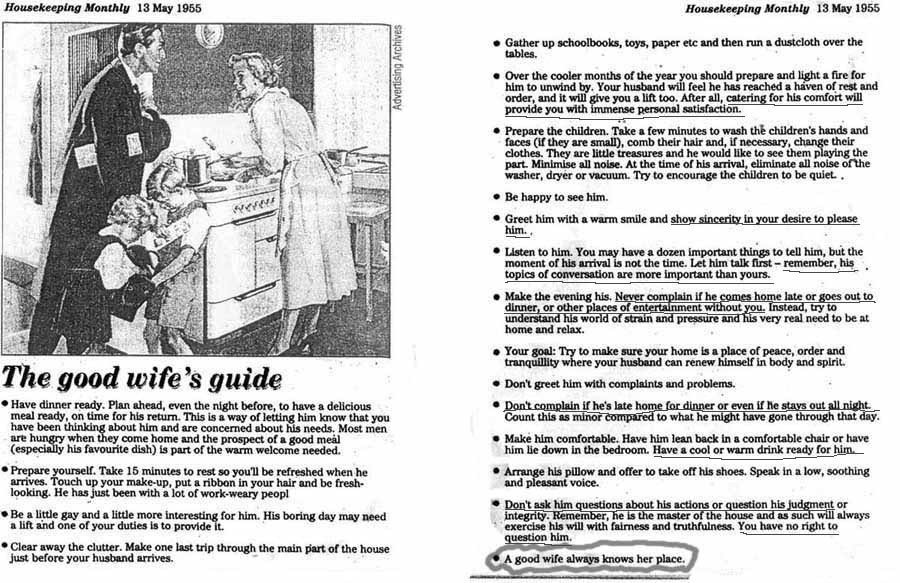
Alien Relationships Discovered on Earth!

In a shocking discovery that has psychologists everywhere buzzing, magazine archivists uncovered evidence today that shows how alien marriages once existed on Earth. According to Dr. Iluk Thruoldstuff, a male staff member with the Dismaying Story Institute, "This 1955 Housekeeping Monthly article proves that husbands and wives once interacted in ways that could only have come from outer space."

The gems of advice offered to wives by this article include:
  • Plan ahead, even the night before, to have a delicious meal ready, on time for his return. This is a way of letting him know that you have been thinking about him and are concerned about his needs.
  • Don't complain if he's late home for dinner or even if he stays out all night. Count this as minor compared to what he might have gone through that day.
  • Don't ask him questions about his actions or question his judgment or integrity. Remember, he is the master of the house.
"My personal favorite," Dr. Thruoldstuff offered, "is the part where a wife should 'Arrange his pillow and offer to take off his shoes.' " The good doc has apparently given up on the idea of ever dating again.

Reaction to news of the article's discovery was swift. The American Husbands' Rights Society issued a press release calling for dramatically increased funding for NASA space exploration. Former US President Bill Clinton announced that he has long been searching for someone who can prove to him personally that this alien culture still exists. The National Organization for Women could not be reached for comment; on the one occasion this reporter was able to get through on their phone line, all that could be heard on the other end was riotous laughter.
-------------------------

Dear Faithful Reader,

The magazine article mentioned above is apparently a fabrication. This snopes.com post debunks the article's apparent source and argues that it is, however, reflective of commonly held attitudes from the fifties and sixties. As an illustrative example, snopes.com lists a number of wifely do's and don'ts from Helen B. Andelin's 1963 book Fascinating Womanhood that are chillingly similar to those from the fictitious Housekeeping Monthly feature.

We are all products of the environments in which we were raised. The next time you are tempted to be frustrated by the differences in attitudes between you and your elderly parents or grandparents, remember they grew up during a time when home economics textbooks offered vastly different messages than those delivered today.

All the best,
Andrew

Do you have a relationship issue in your life? Tell me about your situation and it may be featured as a Dismaying Story. Comments can be anonymous and the identity of email respondents always remains confidential.
Read More ->>

Thursday, August 31, 2006

Dismaying Story #43: The Not So Handyman


Dear Andrew,

My husband and I have been married for six years and our house is a mess. From the outside it looks like we are always in the midst of a yard sale. Many repairs are needed but nothing gets done unless I roll up my sleeves and do it myself.

My husband says all the right things when I go to him with my problems. He agrees to comply with my requests. He agrees to clean up his messes and give me my own set of tools (like I used to have before he took over). He agrees to stop spending money on foolish things and instead put the money in house repairs and badly needed upgrades. He agrees to a lot of things.

His job is seasonal, so he promises that when winter comes he will get projects done around the house. Instead, he spends money (that was supposed to help us make it through the winter) on eBay for his expensive hobbies. Three winters in a row he has done this. He lied to me about the spending, finally confessed, and then continued to do it. No projects were ever done.

Then he will say, "When summer comes and the days are longer, I will get the projects done." In other words, they will never get done.

This has been going on for our entire marriage. I noticed early on that he didn't pitch in and help me with projects like painting or yard work. Yet, I helped him with things that are typically considered man's work. I assumed we were a partnership and we would help each other. In fact, he never even gave me a word of appreciation.

All the while his demeanor is so sweet and kind. His voice is always sounds caring. He portrays to the world the image he wants them to believe.

So, when he does not follow through on what he says he is going to do and I approach him about it, he lies, pouts, or leaves.

Finally, I got an answer from him as to why he is that way. He said, "I don't want to do things on your timetable." In my opinion, he resents me and is taking out his anger by NOT doing anything. He won't confront me because that might make him look like the "bad guy." It is so confusing because, as I said, he says the right things and he appears outwardly to be caring. He hugs me and tells me he loves me but his actions say otherwise. (By the way, he does not demand anything of me. He couldn't care less if I do any housework. He doesn't even eat dinner with me. He eats a bag of popcorn or candy. So I feel that I have no value in his eyes).

I thought we were making progress in counseling, but then he decided he wanted a motorcycle. That would be fine if the clutter was gone and we had the money, but none of that is true. I became so angry that I cut up the carpet, which was badly in need of replacement anyway. The next weekend, I painted the living room, bathroom and bedroom -- no easy task. When my husband came home I told him I was able to move all the furniture, but was not able to move the bed back in place. He said, "That's ok." That's ok? I wasn't asking for forgiveness or approval. I would have liked him to say: "Wow, I can't believe you moved the furniture in the first place. And the paint job looks great! Thanks for getting that done for us. I know it wasn't easy." Just half of that would have made my day.

He doesn't get it from my point of view, which leaves me with anger issues toward him. Sometimes I feel like the marriage is probably over. Can you tell me what is wrong with this guy?

Signed, Feeling Useless and Ignored


Dear Definitely Useful,

I would have to talk with your husband to get the full picture. I can draw a few conclusions, though, based on the following facts from your story:
  • Your husband is willing to live in a mess, while you are not.
  • He is aware of your needs and yet he does not step up and take care of them, despite promising to do so.
  • He does a poor job of making you feel valued and loved.
  • You exhibit considerable anger toward him.
All of this is so problematic that the two of you are in counseling, which sounds appropriate for your situation. When angry emotions make it difficult to make progress by yourselves, it can be good to have an independent third party to help smooth the way.

I suspect several factors are at work. The first is what I would refer to as a maturity issue with your husband. When we are young we often are free to dedicate much of our time and energies to playing with hobbies. As life progresses, however, we must learn to balance these activities with adult responsibilities. Your husband consistently chooses to have fun without taking care of business first. Money and household repairs are obviously large issues for the two of you, yet he plays the winter away without first addressing either of these problems. He could help your situation tremendously if he learned about "work before play."

He sounds as if he is able to do the household projects. He has the tools, is able to hold down a seasonal job, and shows enthusiasm and energy when it comes to his hobbies. The question, then, is why he doesn't want to take care of the house repairs. Part of it might be simple laziness but I don't think that is the answer. Like I said, he shows plenty of energy for the activities that interest him.

I suspect you came very close to answering your own question when you suggested that he harbors resentment. The incident with the carpet shows that you sometimes express your anger in demonstrative ways. I'm guessing he has probably heard plenty of loud and angry words from you. He, on the other hand, has difficulty expressing himself freely and truthfully. He bottles up his feelings and says mostly nice things, even though it is clear there are issues between you. The two of you have considerably different personalities when it comes to resolving conflict, and you have yet to find a way to make these different approaches work together effectively.

I get the sense you feel like you have little control over the relationship. He "inherited" all the tools, which wasn't by your choice. The projects didn't get done, though you would like that to happen. Money is spent in ways you would not choose. You feel powerless.

The first thing I would like you to come to grips with is that you have considerably more control than you realize. You are half of the relationship. He acts, you react, then he reacts to what you just did. In other words, you have just influenced his actions. Unfortunately you don't seem to be influencing his actions effectively, in directions that would strengthen your marriage.

For instance, you express plenty of anger and frustration. What has that bought you so far? Does it elicit the behavior from him that you want? Obviously not. Instead you get a passive aggressive response where he says all the right words but doesn't follow through.

So it's time to put on your thinking cap. What actions on your part might encourage him to respond differently? For example, what if you calmly suggested making an action plan to take care of a specific household project? Pick a task that is obviously doable, pick a date or timeframe when you know he is available, and ask him if he thinks that would work.

Based on your history, I understand how you might feel you are way beyond asking. You might feel that demanding is more appropriate at this late stage, that he has not earned anything better. Asking is almost certainly the only way, though, to get the result you want. You need to empower him, to make him feel valued, like you think he is competent. You need to stroke his male ego. Let him know that despite all that has gone on, you still have confidence that he can do a good job on these projects. If you give him a demand, he will resist as a way of retaining his place in the household pecking order. Instead, ask his opinion. "What do you think dear? Which day would be better for you, Wednesday or Saturday?" Then, when he suggests next Tuesday, give him some enthusiasm. "Sure, that would be great!"

Find ways to "catch him being good" so you can heap praise on him. Show him how much you appreciate his efforts. He must do something around the house, like taking out the garbage. Start the process of change by reacting positively to his efforts. Do more than just say "I appreciate that." Give him a smile, a hug, a bottle of beer -- whatever will make him feel good in some tangible way. In cases like this, actions speak louder than words. (You already know this; his supportive words have meant little compared to his unsupportive actions. Don't make the same mistake in the other direction.)

"Wait a minute," I can hear you saying. "You mean after all he has put me through, I'm supposed to be nice to him? How is that even remotely fair? Why should I have to be the one to fix this? He's the one who wouldn't do the projects. He's the one who lied to me. He should be the one to change, not me."

Sure, that is the result you want. The problem, though, is that you can't control his actions. You do, however, have complete control over your own actions and can use that to influence him. In every problematic relationship, someone has to be the one to step up first. Someone has to say, "This isn't about who is right and wrong anymore. I just want things to change, so I'll start by changing my own behavior."

More than that, you need to accept responsibility for your role in creating the mess you are in. He has been reacting to you. You chose your own behavior, so in a sense you chose his reactions as a consequence. If you accept this as a problem with "us" instead of simply a problem with "him" then you will be closer to the positive mindset you need to work toward a more effective solution.

This might sound like a knock on you but it really isn't. You are in a tough situation and have reacted in an understandable way. Don't give yourself a hard time over what you may or may not have done in the past. Instead, take this as an empowering message -- there is something you can do.

I feel like this discussion addresses only one dimension of your complex situation, but it is a critical aspect of your relationship. He obviously doesn't react well to anger and criticism. If you can recognize that, I suspect you will be closer to identifying and using more effective motivators for his personality type. Hopefully that will open the door for him to reciprocate and to start making you feel valued as well. Kindness and supportiveness tend to be contagious. By showing appreciation toward him, you may find the same thing starts to happen in the opposite direction.

All the best and good luck,
Andrew

If you haven't already done so, don't forget to check out this week's Ask the Faithful Readers question. I will post my favorite response on Saturday with a link to the winner's blog.

Also, if there is anything you would like to know about me or this site, now is your chance. Your interview questions are needed so I can be interviewed online. You can find the details here.
Read More ->>

Wednesday, August 30, 2006

Retailers Flummoxed Nationwide

Retailers across the nation are scratching their heads in wonderment today in response to a run on plus-size aprons. Most stores have sold out and huge crowds of frustrated customers are reported in several locations.

"It's the most bizarre thing I've ever seen," one Wal-Mart manager said, shouting to make himself heard above the din of angry people. "All of a sudden every guy in town wants an apron and their wives seem just as anxious for them to buy one. And all the men have this odd look of desperation on their faces."

The unexpected demand has retail analysts scrambling for an explanation. So far the theories include the obvious need to make lunches for school, or possibly the late summer handyman projects where men prepare their homes for fall and winter.

Perhaps the most persuasive theory, though, was advanced by a bemused group of women standing outside a local shopping mall and watching the ruckus.

"There is nothing more appealing than a man willing to put on an apron for the sake of a woman's happiness," Mother Jones RN said. "When my husband's in the kitchen, he's the sexiest man alive."

Other bystanders chimed in with similar opinions. "My husband has figured out that if he helps his wife out around the home," Karmyn R said, "she is more likely to have sex with him instead of being 'too tired and stressed out!' "

This left Julie Julie Bo Boolie and Jellyhead nodding in agreement. "There is nothing sexier," Julie said, "than a man loading the dishwasher, washing the floor or bathing and putting his children to bed. I mean absolutely nothing!"

JBWriterGirl went so far as to put it this way: "One afternoon my husband offered to take over a refinishing job I was doing. He strained and groaned and I saw muscles I'd never even realized he had. Was I horny? You betcha."

Conclusive evidence for this "Foreplay by Dishwashing" theory showed up minutes later when two burly men in one store struggled over the lone remaining apron and ended up tearing it into two pieces. "Now you've done it," one of them shouted as he waved his half in the other man's face. "How am I supposed to look sexy in this?"

-------------------------------

Dear Faithful Readers,

Your comments a couple of days ago were simply too juicy to pass up! Thanks to everyone for all the input, and to JBWriterGirl, whose The Not So News/JBLA site inspired the format.

Coming up tomorrow: Dismaying Story #43: The Not So Handyman. This is the story of a woman who has trouble getting her husband to pitch in with handyman projects around the house, the ones that guys traditionally look after. I'll examine some of the underlying causes of their conflict, including how issues like this are often not as one-sided as you might think.

See you then!
Andrew
Read More ->>

Monday, August 28, 2006

Dismaying Story #41: Traditional Work Sharing - Does It Work?


Dear Andrew,

I am a proud husband and father of one great 18 month old baby. My wife has been a stay at home mom for almost two years. My wife does a great job with our son. My problem is that I get upset when the house isn't clean, laundry isn't done, or when there are dirty dishes etc. everywhere.

Before we were married, we discussed our wishes of having her home to be with the kids.

I was raised with a working mom who always had a spotless house.

Should I expect my wife to do all of the housework? Please help me understand what you would consider to be correct expectations.

Signed, Husband Who Doesn't Help Around the House


Dear Husband,

Sure, you can let your wife do all the housework, especially if you would like her to be overstressed, overworked, more crabby than she needs to be, less able to cope with your baby's needs, more likely to be depressed and have high blood pressure, and less likely to find you sexually appealing. Hey, if that's what you're aiming for, then by all means camp out on that couch while she works away.

Regular readers of this site will be aware of a continuing series of articles I have been running, which I refer to as The Hunt for the Vacuum Cleaner Gene. The most recent installment in that series, entitled The "It's Only A Little Work" Excuse, discusses how research shows inequitable work sharing arrangements have negative consequences not only for the couple, but also for their children. I suggest Husband should read that article.

Today's question is not part of that series but it very well could be, because it raises a very relevant issue. Many of us learned how spouses "should" interact by watching our parents. In this case you say your mother always kept a spotless house and now you expect your wife to do the same. Girls are commonly raised to have the same expectations for themselves, although your wife may not feel that way -- there must be some reason you wrote to me.

My experience has been that working fathers can sometimes have a skewed perception of the workload their stay-at-home wife faces. Dealing with a baby is a full-time job during the day. The child needs bathing, changing, feeding, entertaining (LOTS of entertaining), walking, soothing. Then there are all the tasks she must do to support those activities, like running out to buy diapers or formula, preparing bottles and food, preparing and cleaning up after the bath, laundry, and so on. It is no secret that the amount of housework explodes when little ones arrive.

That lunch hour you got? And the leisurely ten minutes you spent talking to a co-worker by the water cooler? She doesn't get those types of breaks. Instead, she gets the mind-numbing stress of rarely having an adult conversation anymore. She faces a never-ending stream of tasks she must perform, many of which could be categorized as drudgery.

Now back up and realize that her job didn't begin at the same time you arrived at the office. She was probably up a few times in the night and your baby required care from the moment your wife got out of bed in the morning. To catch up on that lost sleep (and to have the energy required for the evening and the next night) most moms truly need to nap during the day when the baby naps. There is just no other way to fit in a decent amount of rest during a 24-hour period.

Your expectation, however, is that she should forego this need. Instead, during those times when the baby does not demand immediate attention, she should make sure ALL the housework gets done up so you can walk into a spotless house when you come home from work.

To me, that is clearly an unfair expectation. In many cases it is the wife who has had the harder workday, not only physically but also emotionally. Don't believe me? Try switching places with her for a week. You'll soon understand.

When you arrive home from work, you and your wife have both just put in a full workday. The two of you are "Even Steven" in terms of your work contribution so far for that day. There is still plenty of work, however, that must be done. Your child still must be cared for until bedtime. The house (which you both sleep in, make dirty, etc.) is still in use and must be maintained for the rest of the day. You both could use a change of pace by that point in the day. You get yours automatically because you leave the office and come home. The only way she gets a change of pace is if you help to provide it.

A "fair" model is to share the workload equally from that point forward in the day. That means she does whatever housework she can through the day, but there will inevitably be more to do while you are around. How is it fair that you should work 8 hours a day and she should work 16 or more? Roll up your sleeves and take care of life together in the evening, then maybe BOTH of you can have a bit of leisure time to enjoy. Sometimes that might be alone time (which is important) and this can also allow the two of you to spend some time as a couple. What a concept -- having some time to strengthen your marriage, even after you have children. I highly recommend it and sharing the housework makes it easier to accomplish.

You are correct in thinking that this model of fairness was not typical in your mother's day, although you might be surprised to learn how many households worked this way even back then -- not as many as today but still a significant number. In my view, however, not all social norms should be automatically carried forward to new generations, and this is a good example. There is growing awareness that the traditional model for domestic work sharing is inequitable, and studies show this model is becoming less common as the years go on.

I urge you to consider becoming part of this trend. You might even find that doing the dishes proves to be a highly effective form of foreplay.

All the best,
Andrew

Do you have a relationship issue in your household? I would welcome your email or any comment you wish to enter using the link below.
Read More ->>

Friday, August 25, 2006

Dismaying Story #39: To Ask or Not to Ask?

Melli asked me to consider the following question posted by TC, who maintains a blog called Twisted Cinderella's Almost Happily Ever After. TC writes:

Dear Andrew,

Do you know those girls? You know, the ones who wait quietly to see if their husband will remember their anniversary (or birthday or fill in other big important event here). She sits quietly simmering ready to pounce on him for forgetting something she has been thinking about and waiting on for days or weeks. And then he forgets, she pounces, foot tapping, arms crossed, face red . . . HOW DARE HE FORGET????

But . . . she remembered. She knew that he would probably forget. She knew that if he remembered he would do something nice for her. So, why play the game. Why not just remind him a few days in advance or even that morning? The way I see it, I would rather have a lovely anniversary that I reminded him about that he went and did something special for, than an anger-filled anniversary that I could have prevented with a few simple reminders.

I think some girls like catching their men in the act of showing that they don't care as much as the girls do. I think that is malarkey. Some guys just don't remember dates. It isn't a big deal if you don't let it be one. Isn't being with someone about more than his memory? If you remind him and he does something special, should that act feel marred in some way because you had to remind him it was coming up?

See I don't think so. What do you think?

Signed, TC


Dear TC,

I can understand both points of view on this issue, so let's look at it from a few different directions.

First I'd like to examine this poor guy you describe, the one with a terrible memory for dates. Perhaps a simple test or two could help diagnose what is going on. Pick one of his special interests. Is he into hunting? Ask him when hunting season begins. Or maybe he is a baseball or football fan. What are the chances he knows what time of year the playoffs start? I'll go way out on a limb and predict he'll be able to answer those questions easily. More than that, I bet those topics will be on his mind as those dates approach. He will remember those dates are coming up soon.

This isn't about his interests, though. You asked about those special occasions most of us like to acknowledge, like birthdays and anniversaries. Okay, take that same husband and ask him the date of your anniversary. Maybe a few truly hapless souls out there won't know (and if this applies to you ... GO FIND OUT!) but almost all husbands will be able to dredge up that date from memory. The same goes for your birthday; he knows it. So why is it so common for those dates to approach unnoticed in the minds of so many husbands?

The answer seems to be that all those irate wives have a point; many women actually do care about special occasions more than their men do. Who knows why this is; the Mars versus Venus phenomenon comes into effect here. He doesn't remember because he simply doesn't attach the same degree of importance to birthdays and anniversaries that you do.

I argue, though, that a lack of excitement about anniversaries does not indicate a lack of caring about you or your marriage. Many guys are deeply in love with their wives but still rank anniversaries right up there on the Ho Hum scale. If you want a guy like this to make a big deal out of the occasion, you must realize he will be doing so primarily for your benefit. You are asking him to do something nice for you. I agree with Twisted Cindy in the sense that it is unreasonable to expect hubby to "care" about your anniversary the same way you do. You might as well ask him to share your enthusiasm for clothes shopping or home decorating. Like it or not, some interests tend to be split along gender lines.

Of course, the guys also benefit from the celebrations. Many times he will end up enjoying the dinner (or party / trip / whatever) and these occasions can be important for creating those special memories that bond the two of you even closer together. Will he realize this ahead of time, though, and be as excited as you? Many guys will tend not to be.

Is it reasonable to expect that our partner "should just know what I want"? This is a common lament. Somehow it feels less romantic, less special to receive a nice turn if we have to ask for it. This can apply not only to gift giving occasions, but also "knowing" what restaurant we would like to go to tonight, what feels good in bed, and so on.

To me, this boils down into "the first time" versus "all the other times." It is silly to expect your partner to be a mind reader the first time a particular issue comes up. Let's say you have been married eleven months. Your first anniversary is coming up and you are excited about it. This is a big deal to you. You go out and buy him a moderately expensive gift and you have hopes that he will make reservations at an appropriately swanky restaurant, or perhaps you are even hoping for a weekend out of town. This is so obviously a big occasion that you don't discuss it with him; you trust him to realize this on his own.

In many cases that would be a mistake. How can you expect the two of you to be on the same page if you haven't talked about it? Here is my first guideline: When it is the first time, talk about your expectations. Work out a common ground between the two of you so both partners know what is expected of them and what they can expect from the other. It might seem less romantic, but you are setting yourself up for disappointment if you expect him to (a) be a mind reader, or (b) have exactly the same likes and dislikes as you.

Then there is the issue of recurring occasions. Is it reasonable to expect him to remember from the second time onward? Yes, but only if you have discussed your desire for him to remember and he has agreed to take on that responsibility. That is my second guideline: The issue of remembering special occasions on an ongoing basis is a separate topic and should be discussed explicitly. This remembering doesn't seem all that important to Twisted Cindy, and that's fine for her. Go ahead and remind him, hopefully when there is still time to make suitably lavish arrangements. Other women, though, feel special when their husband cares enough to remember on his own. That is an understandable desire and a reasonable thing to request from your partner -- to request, not simply to expect without ever discussing it. Ask him to put the dates in his day timer if he has to, or put a big calendar in his workshop. If you explain how important it is to you and he is truly a caring husband, he will find a way.

This is similar to Dismaying Story #28: Care, Give, Repeat. This was about a woman who wants her husband to put a little effort into making special occasions special. In this case they had the explicit discussion; she asked him to remember a few specific occasions. It was a matter of explaining to him how important the issue was to her and asking him to give her the gift of caring and remembering.

What if you go through all that and he STILL doesn't remember your anniversary? I think a certain amount of toe tapping and arm crossing would be in order. She would be justified in feeling disappointed because he didn't live up to his end of the bargain.

Finally, TC suggests that some women might want an excuse to give their man a hard time. This can happen, and tends to be tied into low self-esteem. The cycle goes like this:
  • I feel bad about myself, so I fear I will be treated badly. I am constantly examining his behavior, looking to see if he is doing so.
  • When something upsetting happens, I feel personally attacked. I am certain part of the cause is that others perceive me as unworthy. So I attack, feeling completely justified in "defending myself."
  • He is still here after the argument. He may have even apologized. This proves I have nothing to worry about, at least for the moment. My fear is temporarily fed and I have been reassured.
  • Before long, however, my typical self-doubt thought patterns re-assert themselves and the cycle is ready to start anew.
Some women do get a "fix" of reassurance in this way every time they complain about how they are treated by their husbands.

This pattern is destructive to your relationship and in some cases can turn into a self-fulfilling prophecy. He feels badly about your attacks and may react poorly. He might sulk or be less anxious to attend to your needs, passively objecting to the attacks. You resent his behavior, feel that he is treating you badly, and on you go. Such a pattern can even end in divorce.

I doubt, however, that this is the most common reason why women choose not to remind their husbands about upcoming special occasions. The simpler and more likely explanation is that many women expect men to care about the occasions in the same way they do. A more reasonable approach seems to be to recognize your differences and discuss your desires explicitly.

All the best,
Andrew

Do you have a different opinion about this issue? As always, I welcome your emails and comments.
Read More ->>

Monday, August 21, 2006

Dismaying Story #38: The "It's Only A Little Work" Excuse

This post is part of a continuing series entitled The Hunt for the Vacuum Cleaner Gene. This series uncovers the many excuses we use to perpetuate some old-fashioned stereotypes. Many people believe it is normal and inevitable for women to be responsible for the bulk of the housework and parenting within their household. This series includes motivational posts that argue "why" these beliefs are largely unfounded, as well as instructional posts that move on to discuss "how to" effect change in your household. Today's entry is a "why" topic.

Dear Andrew,

Okay, so my husband doesn't know which end of the mop to wring and can't tell a whisk from a spatula. If he liked the idea of housework he would have offered to pitch in years ago. Why should I go through the bother of trying to get him involved? It's easier just to keep on doing what I've been doing. After all, you know what they say: A little work never hurt anyone.

Besides, there is one thing my husband can never be; he can never be a mother. I know my children need their father too, but while they are young there is no substitute for the nurturing their mother can provide. I feel especially strongly about this because I work and have to miss so much of the kids' lives. I don't want to give up any more time with them than I already do, so I'm the one who looks after them when we're home, no matter how much extra work that means for me.

Signed, Working Hard


Dear Working,

Yes, I've heard that saying about how a little work never hurt anyone and it applies to your husband as well. I also realize change can be scary even when it's for your own benefit. You have a choice between redefining your role in your household or proving to yourself that you don't need to. I can tell you're busy working on the proof.

Domestic work issues can have a big impact on quality of life for everyone in your family. Researchers have uncovered the following facts about living with an inequitable work sharing arrangement:
  • It's not good for your marriage. One study of working couples found that those who feel they are doing more than their share are more likely to be dissatisfied with their marriage.6 On the contrary, husbands who contribute more at home have wives with lower stress levels.4 These women tend to see their men as loving, caring and more sexually attractive.
  • It's not good for your health. The more time people spend performing household chores, the more likely they are to be depressed.3 Beyond that, a lack of fairness contributes more to depression than just doing plenty of housework. Both men and women tend to be depressed more often when the division of household labor is inequitable.1 One survey of working women showed that those who perform the greatest percentage of domestic work also have the highest blood pressure levels.2
  • It's not good for your children. Studies show that fathers who are more heavily involved in housework and parenting are more effective role models for their children.4 Such children tend to get along better with others, be more outgoing, have fewer behavior problems at school and be less depressed. They also achieve higher school grades.5
Your attitude towards your children sounds noble but I doubt you're achieving the results you hope to, for a variety of reasons. First of all, I don't buy the argument that your children are somehow getting less of you when your husband is helping out. The kids actually get a full dose of Mom and a full dose of Dad whenever the two of you work together to look after them. As I talked about in Dismaying Story #11: Mom's Bonding Time, your children really are able to enjoy the company of more than one person at a time.

More than that, they will have a Mom who is less stressed and more fun to be around if she is not so overworked all the time. Allowing your husband to share the burden can help to achieve that.

Finally, your husband can pitch in with the more mundane housework and parenting chores, such as cleaning up messes and preparing meals. These are tasks that tend to prevent you from paying attention to your kids. With less time needed for these activities, you can have more direct interaction with your children.

If you are wondering whether you should bother getting your husband to help out more, consider how important these issues are to you. To provide the best care possible for yourself, your marriage and your children, get your husband to pitch in.

All the best,
Andrew

I'm going on vacation for a few days, so I won't be posting stories again until late in the week. Until then, I would like to ask two favors:
  1. If you haven't already done so, don't forget to check out this week's Ask the Faithful Readers question. I will post my favorite response next weekend with a link to the winner's blog.
  2. Also, if there is anything you would like to know about me or this site, now is your chance. Your interview questions are needed so I can be interviewed online. You can find the details here.
References:
1. Bird, C. Gender, household labor, and psychological distress: The impact of the amount and division of housework. Journal of Health and Social Behavior, vol. 40, 1999, pp. 32-45.
2. Brisson, C., Laflamme, N., Moisan, J., Milot, A., Masse, B. and Vezina, M. Impact of family responsibilities and job strain on ambulatory blood pressure among white-collar women. Psychosomatic Medicine, vol. 61, 1999, pp. 205-213.
3. Glass, J. and Fujimoto, T. Housework, paidwork, and depression among husbands and wives. Journal of Health and Social Behavior, vol. 35, 1994, pp. 179-191.
4. Lovekin, K. When dads clean house, it pays off big time. UC Riverside sociologists say men likely to have better behaved children and wives who find them more sexually attractive, University of California-Riverside Public Release, June 2003.
5. Radin, N. and Russell, G. Increased father participation and child developmental outcomes. In Nontraditional Families: Parenting and Child Development (M. Lamb, ed.), Erlbaum, 1982.
6. Wilkie, J., Ferree, M. and Ratcliff, K. Gender and fairness: Marital satisfaction and two-earner couples. Journal of Marriage and the Family, vol. 60, 1998, pp. 577-595.
Read More ->>

Saturday, August 12, 2006

Dismaying Story #30: No More Time to Give

Dear Andrew,

My husband is a full-time college student and last year he opened up his own business / office. I have my own business to run, which takes about thirty hours a week of my time, plus I look after our three year old and do the domestic chores galore. I'm always picking up messes. I mow the lawn, take out the trash and it is a never ending circle. There is absolutely no "me" time.

Our financial situation adds to the stress. My husband's business only brought in $15K in profit last year, since much of the revenue went into covering the rent / utility / operating costs of his office. It seems to me it would make more financial sense to go back and run things from here at home, but his philosophy is "Once you step forward you don't ever step back." I have to do all the childcare because we don't have enough money for daycare. I sit here battling fleas and roaches because we can't afford an exterminator.

I believe I am giving 100% PLUS on the support side (I even help him with his homework!!) but now he's telling me to sit at his office and help out for hours during the week. I have two new customers of my own I can't get to -- I just don't have the time.

Am I stingy or something? Is it me? I'm sure feeling quite obstinate over this battle.

Signed, Overworked and Overstressed


Dear Overworked,

I had my scorecard out and a big black marker in my hand while I read your letter. Your husband has two full-time jobs. You have a three-quarters time "official" job. You are also a primary care mother and homemaker, which in my books is more like a job and a half. It runs from the moment you wake up until you give up on that last pile of laundry and go to bed at night. Add to that all the tasks your hubby might normally do if he were not so busy: the yard work and a portion of his homework. To be on the conservative side, I'll call that a quarter of a job, in the range of 10 hours a week or so.

So by my scorecard, here are the number of full-time jobs you are each currently doing:
Hubby - 2.0
You - 2.5

The 2.0 for your husband might be a little low, since new entrepreneurs are often forced to go the extra mile to try to get things moving. His number might be closer to 2.5 as well.

Let's just pause there for a moment and think about this. You are both putting in crazy long hours. You have virtually no time for yourself or, I'm betting, for your relationship. When was the last time the two of you went out and did something fun together? You have a small child at home, which is a joy but also means extra stress. Money is tight, which means your living conditions aren't exactly what you would like them to be, to say the least.

Criminy, is it any wonder there is tension between the two of you? You're living in a pressure cooker and the steam is turned up full blast.

A couple of things occur to me that you might want to think about. First, I believe it is a telltale sign that your husband is asking for more help from you. He may not have a good understanding of this situation from your point of view. It is unfortunately all too common in our society for people to downplay the effort involved with being a primary care parent and homemaker. I suspect in his mind the job scorecard might look something like this:
Hubby - 2.0
You - 0.75

He has two official jobs, while you "only" have a three-quarters job. Therefore, his harried and overworked brain reasons, you are the one with extra capacity. You are the one who should step up and help to bail the two of you out of this tight situation. As you know very well, that is simply not true. You barely have time to shave your legs let alone take on another part-time job with his business.

So one step you might take is to educate your husband about the workload involved with being a homemaker. The most effective method I have heard for this is to get him to take on your role for a few days. When Momma takes a trip and leaves Hubby in charge, he often has a much better appreciation for her workload by the time she returns. In fact, he usually can't wait to scurry back to the office so he can rest up.

My second concern has to do with the way the two of you work out compromises. You wonder whether out-of-home business premises make the most sense right now, but it is your husband's philosophy that determines the course. You used the word "telling" instead of "asking" when you said, "he's telling me to sit at his office..." Was that merely an unfortunate choice of word, or do you have somewhat of a "he tells, she listens" type of relationship? He is obviously comfortable asking you for help; are you equally comfortable stating your needs?

Many women are givers by nature. You give and you give and you wait for him to reciprocate ... and feel badly if it doesn't happen. Many men, on the other hand, will assume that if you're not asking, you don't need help. They assume this because that is how they operate.

Let's say the two of you are on your way to a wedding and he isn't quite sure how to find the church. He hasn't asked for help but you pipe up and offer to call somebody for directions. What is he likely to do? Many men will scowl and say, "I can find it." Unsolicited help can be an insult, an indication that you don't believe he is competent. Since men don't like to be offered unsolicited help, they are not always great at doing so for others. They will wait to be asked.

Do you ask your husband for help? I don't mean indirectly like, "I sure am tired today." I mean, "Will you take out the trash now please?" Some women contribute to your own workload because they don't realize how little they actually ask for help.

Finally, the two of you need a plan, a way to escape the pressure cooker. His plan is to get you to contribute more, to help his business succeed so it can take the two of you to the promised land. Since you have no more time to give right now, this seems to be an unrealistic plan.

What can you look forward to that will offer some relief? He will finish his studies at some point, which should help lessen the overall household work burden. If either or both of your businesses become more successful, the extra income can provide childcare, better living conditions and maybe even (dare to dream) help cleaning the house once a week. Money may not buy happiness, but it certainly can buy away some drudgery.

Those are medium-term measures, though. In the short-term it seems you and your husband have two choices. You can proceed as you are and keep your sanity by having faith that changes are coming down the road. Often it is easier to withstand hardship if you know (or even believe) that the cavalry is just over the next hill.

The other option is to open a vent in the cooker and release some steam right away. Do you truly believe that operating your husband's business from home is a better option right now? Might that save some money and make life a little easier? I have no way of knowing; perhaps he would lose customers without the image provided by having professional premises. Perhaps he would incur additional costs by breaking his lease and then having to re-establish the office later. I wonder, though -- have you presented your views on this matter and had a frank discussion about it with him? Or did you mention the idea briefly once and drop it as soon as he stated his "never retreat" philosophy? Yes it is his business, but this decision affects both of you, as well as your child. If you haven't already done so, you should take a hard, objective look at the issue and come to a joint decision.

I don't think you are stingy at all. You are simply already giving all you have to give. Hopefully these ideas might help you find some relief.

All the best,
Andrew

Do you have issues finding balance between your work and home life? Tell me about it and your submission might end up as a Dismaying Story.
Read More ->>